
The Administrative Core of the New Mexico Alzheimer’s Disease Research Center coordinates all center activities and ensures that scientific teams, community partners, and educational programs work together smoothly. Building on years of collaboration, the core has developed strong partnerships across New Mexico—including with Zuni Pueblo, First Nations Community Health Source, and the New Mexico Aging and Long‑Term Services Department—to improve dementia diagnosis and care in both urban and rural Hispanic, Latino, and American Indian communities. These partnerships allow the center to bring advanced services, such as mobile brain imaging and community‑based cognitive testing, directly to medically underserved areas.
The Administrative Core also supports statewide research efforts by organizing training programs, symposia, and developmental grants for early‑career scientists. It manages daily operations, oversees data submission to national repositories, and helps guide research on inflammation, precision‑medicine approaches, and new methods for classifying dementia. As the first Alzheimer’s Disease Research Center in the vast region between Mexico and Canada, the center plays a vital role in expanding access to cutting‑edge dementia research and care for New Mexico’s diverse and geographically dispersed communities.
Read More >>
The Clinical Core leads the development of a diverse, long‑term participant cohort to advance understanding of Alzheimer’s disease and vascular cognitive impairment in New Mexico’s communities. By partnering closely with other center cores, it recruits individuals across the disease spectrum—with a strong emphasis on American Indian and Hispanic/Latino representation—to support research on early disease mechanisms, inflammation, and neurovascular health. The Clinical Core also incorporates sociocultural factors into assessments, develops culturally informed approaches for sharing results, and helps train the next generation of dementia researchers. Through this work, the Clinical Core promotes equity in research, strengthens resilience, and supports healthy aging across the region’s diverse populations.
Read More >>
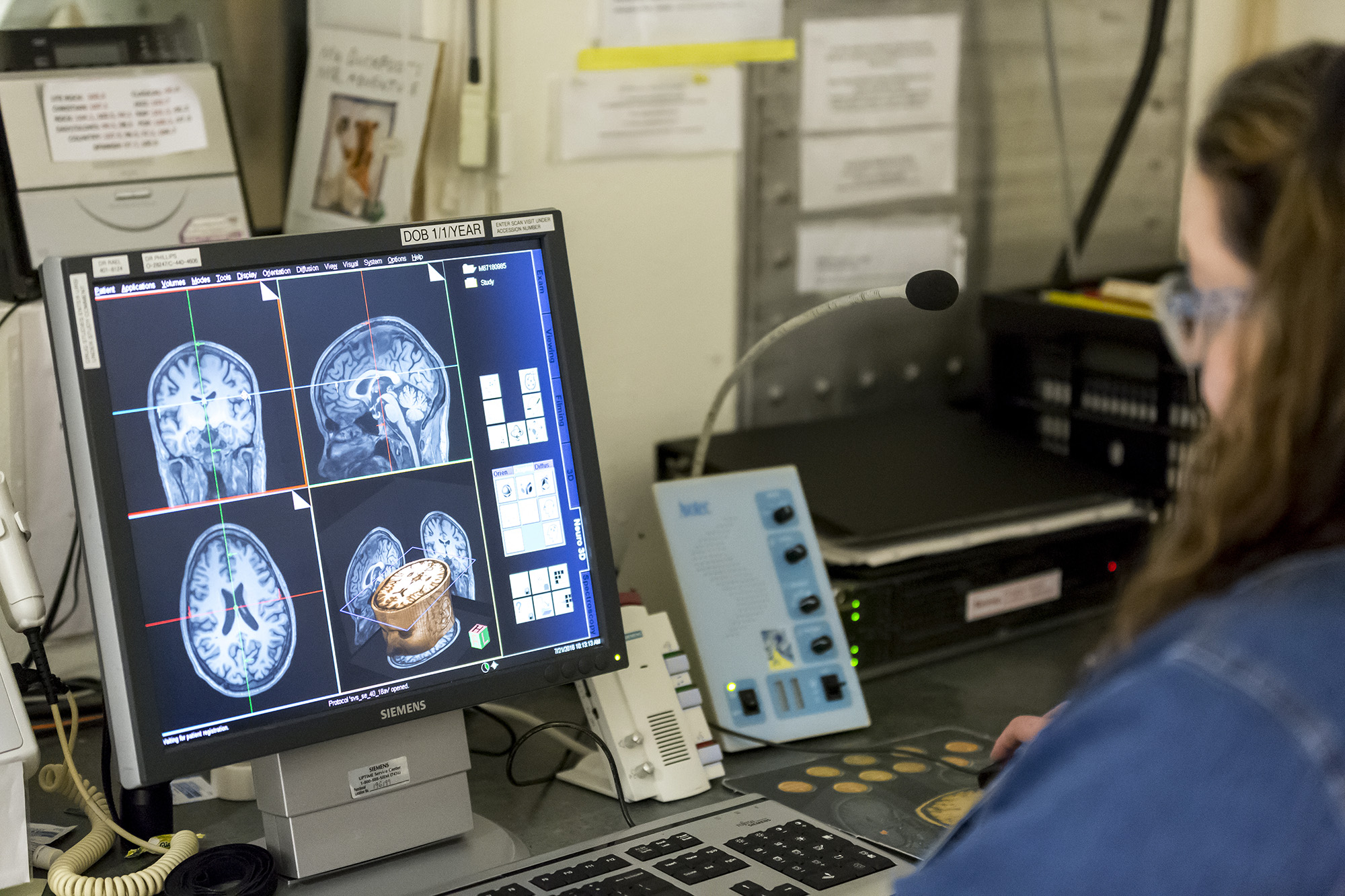
The Neuroimaging Biomarker Core supports the New Mexico Alzheimer’s Disease Research Center by delivering state‑of‑the‑art imaging and data analysis to better understand vascular and inflammatory factors contributing to Alzheimer’s disease and related dementias (ADRD). Our work is especially focused on serving New Mexico’s diverse and historically underrepresented communities, including American Indian and Hispanic/Latino populations.
In alignment with the neuroimaging goals of the National Alzheimer’s Coordinating Center, the Neuroimaging Biomarker Core collaborates closely with the Clinical Core and the Data Management and Statistics Core to develop biomarkers that capture susceptibility, risk, and disease progression related to vascular contributions to ADRD.
The Neuroimaging Biomarker Core provides ante‑mortem, post‑mortem, and fixed‑tissue MRI scans to the Neuropathology Core to support imaging–histopathology comparisons. In partnership with the Outreach, Recruitment, and Engagement Core, we train researchers in advanced MRI methods and offer community‑focused education on the value of neuroimaging in dementia research.
Read More >>
The Biomarker Core works to better understand the biological changes that lead to Alzheimer’s disease and related dementias. Our team studies both brain imaging and blood‑based markers to learn how vascular disease, inflammation, and neurodegeneration each contribute to memory loss.
Traditional diagnostic tools often require invasive procedures or expensive scans. By developing highly sensitive blood tests, we aim to make early detection more accessible—especially for people living in rural areas of New Mexico. These blood‑based markers can help identify individuals at risk much earlier and may open the door to participation in new clinical trials.
We also study how changes in the brain’s blood vessels and inflammation relate to cognitive decline. By combining blood tests, brain imaging, and cognitive assessments, we are creating more accurate ways to distinguish between Alzheimer’s disease, vascular dementia, and mixed forms of dementia. This work is especially important for Hispanic/Latino and American Indian communities, who experience higher rates of vascular disease but are often underrepresented in research.
The Biomarker Core shares data with national research programs to help improve dementia diagnosis and care across the country. We also support researchers at the University of New Mexico and train future scientists who will continue advancing dementia research.
Read More >>
The Neuropathology Core helps researchers understand how Alzheimer’s disease and other dementias affect the brain. With permission from donors and their families, the core studies brain tissue after death to identify changes related to memory loss, vascular disease, and inflammation. This work is especially important in New Mexico, where many residents come from communities that have been historically underrepresented in medical research, including Hispanic/Latinx and American Indian populations.
The core works closely with the University of New Mexico Brain Bank, which holds hundreds of donated brains from people across the state. By studying these donations—along with information collected during life, such as brain scans, blood tests, and memory evaluations—researchers can better understand what causes different types of dementia and why they affect people in different ways.
The Neuropathology Core also uses advanced tools, such as high‑resolution imaging and modern molecular techniques, to study how brain cells change over time. These discoveries help identify new targets for treatment and improve the accuracy of diagnosis.
In addition to research, the core creates educational materials to help families, students, and community members learn about the scientific and cultural importance of brain donation and dementia research. All findings, data, and materials are shared widely to support scientists in New Mexico and beyond.
Read More >>
The Outreach, Recruitment, and Engagement Core helps ensure that Alzheimer’s disease research in New Mexico reflects the people most affected by it—especially rural communities, Hispanic and Latino families, and American Indian Nations. Many of these groups have been left out of research in the past, and the core is committed to changing that through long‑term, respectful partnerships. Instead of relying on one‑time outreach or traditional recruitment, the core works directly with community leaders, caregivers, and people living with dementia to understand their needs, priorities, and concerns. By building trust first, the core creates a foundation for meaningful participation in research.
Through these efforts, the Outreach, Recruitment, and Engagement Core aims to strengthens relationships across the state and to increase opportunities for underrepresented communities to participate in Alzheimer’s disease research. The works to improve early detection, prevention, and care for future generations.
Read More >>
The Data Management and Statistics Core ensures that all information collected through the New Mexico Alzheimer’s Disease Research Center is accurate, secure, and useful for advancing research. The data team organizes clinical information, brain imaging, and donated biological samples, making sure everything is complete, high‑quality, and submitted on time to national research programs. They also provide secure access to anonymized data so scientists in New Mexico and beyond can use it to improve understanding of Alzheimer’s disease.
The statistics team supports researchers and students by helping design studies, analyze data, interpret results, and prepare scientific papers and grant applications. They also develop and use modern analytical tools, including machine‑learning methods, big‑data techniques, and advanced imaging analysis, to make sense of complex information from brain scans, clinical evaluations, and biomarker tests.
Together, these teams strengthen research across the center and play a key role in understanding how vascular and inflammatory factors contribute to Alzheimer’s disease and related conditions in underrepresented communities across New Mexico.
Read More >>
The Research Education Component helps train the next generation of scientists who will study Alzheimer’s disease and related dementias. The program builds on the University of New Mexico’s strengths as a minority‑serving institution and creates training opportunities that reflect the cultural and scientific needs of New Mexico’s diverse communities.
We offer inclusive, hands‑on learning experiences for students, trainees, and early‑career researchers. Our focus is on understanding how vascular and inflammatory factors contribute to Alzheimer’s disease and cerebrovascular disease, especially in underrepresented groups across the state. We support trainees as they learn research skills, connect with mentors, and prepare for careers in biomedical, behavioral, and clinical research.
The program also strengthens the broader research workforce by creating a welcoming, multidisciplinary learning environment. By emphasizing cultural responsiveness and community‑centered approaches, we help prepare future scientists to design innovative studies and improve care for diverse patients and caregivers.
Through this work, the New Mexico Alzheimer’s Disease Research Center contributes to a national effort to expand who participates in research, who leads it, and who benefits from the discoveries that follow.
Read More >>
Center for Memory and Aging
Mind Research Network
Pete and Nancy Domenici Hall
1101 Yale NE Albuquerque, NM 87106 (map)
Main phone number: 505-272-3315
Fax: 505-272-7652